My head has been spinning since class on Tuesday. There's just too much. I can't do any of it justice, but I'll put down some of my notes, and hopefully they will spark some thought in others! Some of this is from Ratzinger's God is Near Us, but not sure which parts.
The human body does two things: It enables us to encounter others. It expresses me, the reality of the person, and allows us to communicate. But it also prevents us from knowing each other fully. It is like a border between states- it gives form to the state, but also separates it from all others. So the human being always has a decision to make: to allow oneself to be known, to give oneself, or to cave in. Because of original sin, we tend to cave in on ourselves. But in the Resurrection, the body becomes just communication. That is why Jesus can be fully present, His body can be in the Eucharist, in the Church, in US, everywhere, and does not separate us from Him. The Church is where the communication of God takes place. God wants man to participate in His life- this is much more than not sinning, but is being someone with whom He can talk... Dialogue! God seeks a return of His love.
We are called to have the soul of the Church; Our souls should be enlarged and welcome the other... which requires us to change. The center of our self should be no longer the self but the other... In St. Paul, just as it is Christ who lives in him, he also carries the community of believers in him as well. God places the destiny of others in human hands. Look at the saints. Their lives were defined by Christ, and they knew the urgency of communicating Him to others. We are all called to participate inChrist's mission- He lives in us. Some missions reach further than others (that is why we only canonize some) but we all participate in it. The whole Church is in me. If you are baptized, you are a part of me... not in a sentimental wishy-washy sense, but in a reality of having been made one by the sacrifice of Christ. The entire Church is in me. I carry you- and you carry me- for He carries us all.
Thursday, November 17, 2005

Awww. haha
From Philothea Rose (Check out her cute baby!!!)

innocent kiss - you're cute and sweet and like it
that way
What Sign of Affection Are You?
brought to you by Quizilla
innocent kiss - you're cute and sweet and like it
that way
What Sign of Affection Are You?
brought to you by Quizilla
Tuesday, November 08, 2005
Got nothin'
Not that there's nothing going on, but I just don't feel I have anything to "publish" for the world at large these past days/weeks/whatevers. Work is still slow, but I have had a bit more to do than usual, and have kept up with reading other blogs and news stories, so it hasn't been too painful.
I performed for the first time in front of people on Saturday (sang/played guitar). Well, let me be more specific. Put me on stage in front of 500 strangers, and I'm like a fish in water. Put me on one side of a living room full of people I know and I feel paralyzed. It's always been that way, so I usually avoid that kind of performing, but now that I've done it perhaps next time it will be easier. I got to talk with some really cool people, hear Dan's discernment story and a couple's engagement story (on the feast of the exaltation of the Holy Cross... awesome!)so it was a nice night. Good people, good tea, and great music.
Well, hopefully I'll have something of substance sometime in the future, but no promises.
I performed for the first time in front of people on Saturday (sang/played guitar). Well, let me be more specific. Put me on stage in front of 500 strangers, and I'm like a fish in water. Put me on one side of a living room full of people I know and I feel paralyzed. It's always been that way, so I usually avoid that kind of performing, but now that I've done it perhaps next time it will be easier. I got to talk with some really cool people, hear Dan's discernment story and a couple's engagement story (on the feast of the exaltation of the Holy Cross... awesome!)so it was a nice night. Good people, good tea, and great music.
Well, hopefully I'll have something of substance sometime in the future, but no promises.
Friday, October 28, 2005
Cool Music
One of the greatest parts of my friendship with Srs. Water and Grass is that we share an intense love for music. Specifically for cool, lesser known artists. So here are a couple I highly recommend, just to throw it out there for any music lovers like Annee or Anj.
Ray LaMontagne, who we call "Ray Lemonade" because we aren't sure how to say his name. I'm telling you, it never fails that when his song "Trouble" comes on in my car, I say "Sing it, Ray!" It doesn't matter if I've had a good day or a bad day, and it doesn't matter what mood I'm in. It's appropriate for all. Sing it, Ray!!
Amos Lee I would place him in the same kind of genre as our pal Ray. They call it a fusion of funk and soul... and that sounds about right. It's soul-ful music alright! Love it.
Hem Sr. Grass heard this band playing in a store when we were in CA, and asked the person working who they were. Apparently, she was the millionth person to do so. It's very nice- some fiddle in there, and fun to sing along to.
These three are all under the general mood of "chill"... Ooooh Ben Harper too. This is just the current mood, there are others.
Wow work is reaaaaal slow today.
Ray LaMontagne, who we call "Ray Lemonade" because we aren't sure how to say his name. I'm telling you, it never fails that when his song "Trouble" comes on in my car, I say "Sing it, Ray!" It doesn't matter if I've had a good day or a bad day, and it doesn't matter what mood I'm in. It's appropriate for all. Sing it, Ray!!
Amos Lee I would place him in the same kind of genre as our pal Ray. They call it a fusion of funk and soul... and that sounds about right. It's soul-ful music alright! Love it.
Hem Sr. Grass heard this band playing in a store when we were in CA, and asked the person working who they were. Apparently, she was the millionth person to do so. It's very nice- some fiddle in there, and fun to sing along to.
These three are all under the general mood of "chill"... Ooooh Ben Harper too. This is just the current mood, there are others.
Wow work is reaaaaal slow today.
SO close!
| You Are 22 Years Old |
 Under 12: You are a kid at heart. You still have an optimistic life view - and you look at the world with awe. 13-19: You are a teenager at heart. You question authority and are still trying to find your place in this world. 20-29: You are a twentysomething at heart. You feel excited about what's to come... love, work, and new experiences. 30-39: You are a thirtysomething at heart. You've had a taste of success and true love, but you want more! 40+: You are a mature adult. You've been through most of the ups and downs of life already. Now you get to sit back and relax. |
Thursday, October 27, 2005
Party Time
Halloween = parties. One tomorrow, one Saturday. I am thus compelled to contemplate proper party conversation and participation. (How do you like those c's and p's?)
It is always helpful to remember that almost everyone in the world doesn't think they are very good at the whole "social thing." It almost never fails that people I think are so calm and cool at making conversation and seem not nervous at all in party settings will later confess their anxiety over that very thing. We all say to each other, "Are you kidding? You're so great! I'm the one who's socially awkward." Just realizing that changes your perspective. We're all just human. In a setting surrounded by people you only slightly know, you are probably going to be a little awkward. You're probably going to have to endure some silences, and lags in conversation, and say some dumb things. You'll tell a story and not know where it's going and it will never get there. You'll be in people's way, a lot if its crowded. That's all a part of it. Part of the human thing. Most people choose to ease this a bit with alcohol. At parties I go to, no one is getting trashed, and they're responsible. I usually don't for the simple reason that I don't particularly like the way most of it tastes. And having been that way forever, I'm used to this awkwardness that is me, and can deal with it fairly well. (Not to say that's the only reason to drink- but if you don't like beer, then it is the reason... meaning, when my roommate makes me a yummy fun drink I don't complain :)
The last time I went to a party at this person's place, I was very struck by how much is going on at one time. Especially in these kinds of circles- you're going to a party with people who examine their consciences. So you know that words are not just coming and going, they will be remembered. Everyone is trying to figure out how to "be good"- even a saint- yet be themselves too. There are crushes, there are disappointments, there are former relationships or budding ones, mixed feelings, hidden ones... the list goes on. And it's all part of the night. God wills somehow that you're standing in this room with this particular group of people. You have the choice of whether you're going to live for others and go outside of yourself (to that person standing alone) or remain comfortably with people you know well. You will have to rack your brain for real questions to ask strangers which don't allow one-word answers, and you'll have to actually care about their response and be open to being surprised. All this while getting over your own self-consciousness, background music that can be distracting, or feelings about this or that person. And since most of these people are in the state of grace, the Holy Spirit is totally present even if we're not having "prayer time." How cool is that?
So my prayer for tomorrow is the strength to be obedient to the Holy Spirit. Follow Him wherever He leads, and if it's to a person who rambles on without stopping for breath in the corner away from all my friends, so be it. For the grace to love them and not make it evident that I would like out of this conversation. (not that I've ever done that... I mean.... shoot I'm a wretch) To be ungrasping of anyone's attention. For humility and the willingness to be set aside. For freedom in my heart, and for it to be protected by Mary in all its vulnerability.
I'm so glad it will be St. Jude's feast day! I'm a hopeless cause :)
It is always helpful to remember that almost everyone in the world doesn't think they are very good at the whole "social thing." It almost never fails that people I think are so calm and cool at making conversation and seem not nervous at all in party settings will later confess their anxiety over that very thing. We all say to each other, "Are you kidding? You're so great! I'm the one who's socially awkward." Just realizing that changes your perspective. We're all just human. In a setting surrounded by people you only slightly know, you are probably going to be a little awkward. You're probably going to have to endure some silences, and lags in conversation, and say some dumb things. You'll tell a story and not know where it's going and it will never get there. You'll be in people's way, a lot if its crowded. That's all a part of it. Part of the human thing. Most people choose to ease this a bit with alcohol. At parties I go to, no one is getting trashed, and they're responsible. I usually don't for the simple reason that I don't particularly like the way most of it tastes. And having been that way forever, I'm used to this awkwardness that is me, and can deal with it fairly well. (Not to say that's the only reason to drink- but if you don't like beer, then it is the reason... meaning, when my roommate makes me a yummy fun drink I don't complain :)
The last time I went to a party at this person's place, I was very struck by how much is going on at one time. Especially in these kinds of circles- you're going to a party with people who examine their consciences. So you know that words are not just coming and going, they will be remembered. Everyone is trying to figure out how to "be good"- even a saint- yet be themselves too. There are crushes, there are disappointments, there are former relationships or budding ones, mixed feelings, hidden ones... the list goes on. And it's all part of the night. God wills somehow that you're standing in this room with this particular group of people. You have the choice of whether you're going to live for others and go outside of yourself (to that person standing alone) or remain comfortably with people you know well. You will have to rack your brain for real questions to ask strangers which don't allow one-word answers, and you'll have to actually care about their response and be open to being surprised. All this while getting over your own self-consciousness, background music that can be distracting, or feelings about this or that person. And since most of these people are in the state of grace, the Holy Spirit is totally present even if we're not having "prayer time." How cool is that?
So my prayer for tomorrow is the strength to be obedient to the Holy Spirit. Follow Him wherever He leads, and if it's to a person who rambles on without stopping for breath in the corner away from all my friends, so be it. For the grace to love them and not make it evident that I would like out of this conversation. (not that I've ever done that... I mean.... shoot I'm a wretch) To be ungrasping of anyone's attention. For humility and the willingness to be set aside. For freedom in my heart, and for it to be protected by Mary in all its vulnerability.
I'm so glad it will be St. Jude's feast day! I'm a hopeless cause :)
OAR
So little do most of us know, there's an intense debate going on over this procedure, designed to give us stem cells without giving us embryos. Here's what one of my professors has to say about it:
ANT-OAR (Warning: Evil PDF format!)
I wish I understood this stuff, but I really don't. I just really trust this guy. It's a Brave New World indeed................
ANT-OAR (Warning: Evil PDF format!)
I wish I understood this stuff, but I really don't. I just really trust this guy. It's a Brave New World indeed................
Tuesday, October 25, 2005

Friday, October 07, 2005
Trinity study time
I realized very strongly on Tuesday that I need to be studying a bit harder. The question, "Well, what does Athanasius say?" was directed toward the class and I found myself thinking, "I have no idea. I know I read it, but I have no idea."
oops. So today at work, I'm going through my notes, and this post will really be just for the purpose of "writing down" a few things, especially any cool points Fr. made.
The problem with Rahner's "On the Trinity" is that he said that the economic Trinity is the immanent Trinity and vice versa. It's the vice versa that causes problems, because the first part is fine- yes, the God in history is the God that exists. But did God express His whole Being in history? Is there nothing left to say? What happens now then? God's being is not welded to the cosmos, He is not totally caught up in history so that He is lost. There is a connection, of course (Romans 1:20), but God is always-greater. ever-greater.
So what does Jesus Christ disclose?
"I am the sent one." He is always in relation to the Father. His mission defines Him, it coincides with Who He is.
*here's where Fr. went off a bit and said some great stuff: human beings always want to be somewhere else- to plan the future. Christ shows His divinity by not anticipating the will of the Father (only the Father knows the hour) Human beings always have the suspicion that the Father is the enemy, and that's why we have to plan things out. Remember, we're always and only in the PRESENT! That's it! Nothing before or behind. And the most evident thing about the present is that we're not making ourselves-- we're being made-- and we resist. We want to break out of time. You can't just pull yourself out of this way of thinking, but Christ shows that the meaning of being a human being is to receive.*
Aquinas: Christ's having a mission coincides with receiving His being in eternal generation. He is defined by receiving Himself. The mission of the Son is the divine procession in history.
Christ talks of God as 3 and as unity. Circumincession, perichoresis...
How do we understand the paradox of one God who is Father, Son, and Spirit?
Look at the 2 philosophical positions that are a background for these questions.
oops. So today at work, I'm going through my notes, and this post will really be just for the purpose of "writing down" a few things, especially any cool points Fr. made.
The problem with Rahner's "On the Trinity" is that he said that the economic Trinity is the immanent Trinity and vice versa. It's the vice versa that causes problems, because the first part is fine- yes, the God in history is the God that exists. But did God express His whole Being in history? Is there nothing left to say? What happens now then? God's being is not welded to the cosmos, He is not totally caught up in history so that He is lost. There is a connection, of course (Romans 1:20), but God is always-greater. ever-greater.
So what does Jesus Christ disclose?
"I am the sent one." He is always in relation to the Father. His mission defines Him, it coincides with Who He is.
*here's where Fr. went off a bit and said some great stuff: human beings always want to be somewhere else- to plan the future. Christ shows His divinity by not anticipating the will of the Father (only the Father knows the hour) Human beings always have the suspicion that the Father is the enemy, and that's why we have to plan things out. Remember, we're always and only in the PRESENT! That's it! Nothing before or behind. And the most evident thing about the present is that we're not making ourselves-- we're being made-- and we resist. We want to break out of time. You can't just pull yourself out of this way of thinking, but Christ shows that the meaning of being a human being is to receive.*
Aquinas: Christ's having a mission coincides with receiving His being in eternal generation. He is defined by receiving Himself. The mission of the Son is the divine procession in history.
Christ talks of God as 3 and as unity. Circumincession, perichoresis...
How do we understand the paradox of one God who is Father, Son, and Spirit?
Look at the 2 philosophical positions that are a background for these questions.
- Plotinus teaches that the more perfect a being is, the more it generates. Generation is a perfection of being. The perfect One is a unity overflowing with life. What is generated cannot be itself; it must be something else, something less. That which is generated is less than and extrinsic to the one who generates. The one generates outside itself.
- Aristotle posits the Unmoved mover, the principle which remains ignorant of all other things. The universe is co-eternal, so the One doesn't mettle in it.
Now within Christianity:
Arius posits that a distinction in God cannot multiply essences. (There are not 3 Gods) He's trying to correct a couple theories going around:
- Adoptionism: Jesus is a normal human being and at Baptism He is granted divinity by the Holy Spirit.
- Modalism: We seem to be dealing with one God who presents Himself in history in 3 different ways. They aren't 3 different persons, just modes or ways of being the same. God's face with 3 expressions... ways God is present to our awareness. Like Sabellianism. Consequence: The Father suffers on the Cross.
Arius is trying to remain faithful to Scripture, defend God's unity, and also affirm the reality of Jesus' suffering and death. Against modalism, he says that the generation of the Son is real- He has a true substantial existence, is not an emanation. The Son is not the Father. When he starts getting in trouble, Arius tries to get out of it through using Scripture to hold that God is one, and that while the Father is ungenerated, all else comes from something else. (Jesus is not equal to the Father)
shoot I didn't get far at all. Lots of work to do!
Tuesday, October 04, 2005
Stand in Reality
We had a professor last year who was young, energetic, handsome, and didn't wear a ring. Then we found out that he was a consecrated celibate in a community. We're talking vows not promises. And suddenly, how you looked at him was changed.
I remember the way my friend explained it. If your vocation is your stand in reality, then this total chang of perception makes perfect sense. When you find out someone's vocation, suddenly you see them in light of this fact, this calling which determines the rest of their being. If you see a man in plain clothes, who then introduces himself as a priest, the same thing happens.
One of the guys who plays soccer never wears a ring when he plays, so I never knew he was married. Then I saw him at a different function the other day, with his wife. And it just clicked- it made him make sense! Now I can see him much more in reality; his stand in it is named. I don't know how to explain it. But there is something in how he plays, in how he affirms everyone on the field, and how fatherly he is that I just couldn't seem to reconcile with a single man and it kind of confused me. And now I see why! How cool!! His marriage defines him in a fundamental way, and it is communicated just in the way he is. He didn't even have to have his ring on, or mention his wife every day for me to know there was definitely something to him, that he was not a normal single guy. I'm wondering if there's a way to tell him that, but I think if people don't know where I'm coming from, the JPII vision, they might think it's... well... strange. "You only made sense to me when I saw you with your wife!"
I remember the way my friend explained it. If your vocation is your stand in reality, then this total chang of perception makes perfect sense. When you find out someone's vocation, suddenly you see them in light of this fact, this calling which determines the rest of their being. If you see a man in plain clothes, who then introduces himself as a priest, the same thing happens.
One of the guys who plays soccer never wears a ring when he plays, so I never knew he was married. Then I saw him at a different function the other day, with his wife. And it just clicked- it made him make sense! Now I can see him much more in reality; his stand in it is named. I don't know how to explain it. But there is something in how he plays, in how he affirms everyone on the field, and how fatherly he is that I just couldn't seem to reconcile with a single man and it kind of confused me. And now I see why! How cool!! His marriage defines him in a fundamental way, and it is communicated just in the way he is. He didn't even have to have his ring on, or mention his wife every day for me to know there was definitely something to him, that he was not a normal single guy. I'm wondering if there's a way to tell him that, but I think if people don't know where I'm coming from, the JPII vision, they might think it's... well... strange. "You only made sense to me when I saw you with your wife!"

Tuesday, September 27, 2005
Contemporary Exegesis
I have a final exam tomorrow in one of my classes. That's right, a final! We'll be done with this class on Weds, have a week off, and start another one the week after. Strange schedule.
First, I'll write about an article entitled, "Christ in Contemporary Exegesis: Where We Are and Where We Are Going" by Klemens Stock. He begins by outlining a few trends in exegesis:
First, I'll write about an article entitled, "Christ in Contemporary Exegesis: Where We Are and Where We Are Going" by Klemens Stock. He begins by outlining a few trends in exegesis:
- The gap between the "historical pre-paschal Jesus" and the "Post-Paschal Christ" is getting smaller. Exegetes are recognizing the problem with both extreme positions. Bultmann, at one extreme, thought the Jesus of history had nothing to give to us. All that matters is the saving act of Christ. On the other hand, we have Jeremais, who thinks that the only important thing is finding details about Jesus according to the historical-critical method and focusing on them. Bridges are starting to be built which recognize the "implicit Christology" present all through the Gospels. You cannot separate Jesus from Christ!
- The search for the "historical Jesus" continues.
- There is growing discontentment with the historical-critical method. Why? a few reasons. Let me list them... First, the method only offers hypotheses, it does not give people the bread of life. It does not help anyone make a decision about how to live their life in the footsteps of Christ. Secondly, the method is divorced from praxis, and turns the study of Christ into a cold, academic one. Third, the attempt to interpret Scripture from the point of view of depth psychology has not been very fruitful. [don't ask me what that means]
- There is a desire to reclaim the "Jewishness" of Jesus. These interpretations tend to dismiss other aspects of Christ as inventions of Paul.
- New approaches affect how we see Christ. Ex: Historical Impact (history of exegesis), Rhetorical analysis (text as a whole), Methodological Reflection (H-C method is critique, analogy, correlation- look at the problems with them).
Next, Stock gives us some guidelines for exegesis, assuming that we want to find Jesus, whole and entire and in Himself.
- Do less violence to the text. Just as we can see the effects in nature when we approach it with our own purpose and make it bend to our wills, Scripture needs to be approached in such a way as it is allowed to speak.
- Respect the Gospels as unique sources. Realize that you cannot separate Jesus of Nazareth from His followers. Christ preached a new way of life, a community. He did not display concern that His words and actions be written down as they went along; rather He was concerned about building a community. The Gospels are testimonies of faith, and this does not make them any less true. They are an inseparable weaving of what Jesus said and did and the effect that He had.
- Continue the historical work. We must respect the age of the text and the tools needed to understand it. This includes looking at literary form, language, intellectual background, context, authors & intentions, addressees & situations, and past interpretation of the text.
- Use the whole as a reference point. To illustrate this point, Stock presents the case of the Gospels of John and Mark. Do they point to the same person, even though one presents us a "High Christology" and one is less clear? (yes- look at the whole of Mark's Gospel and you will find implicit affirmations of the things John explicitly teaches us)
Basically, to find the real Jesus Christ, you must trust that God wants to speak through Sacred Scripture, that He can do that, and that He will help.
NT Passages on Marriage
(Part II of tomorrow's test)
Matthew 19:3-9
Perhaps the most important of all NT passages on marriage since here we have Jesus' own words addressing it. So what does He say when the Pharisees ask Him about divorce?
Matthew 19:3-9
Perhaps the most important of all NT passages on marriage since here we have Jesus' own words addressing it. So what does He say when the Pharisees ask Him about divorce?
And Pharisees came up to him and tested him by asking, "Is it lawful to divorce one's wife for any cause?"
Note here that the Pharisees presuppose the lawfulness of divorce. They see marriage as a contract that is subject to the husband's will. The question, in their minds, is whether Jesus has a strict or loose interpretation of the law (for any cause).
He answered, "Have you not read that he who made them from the beginning made them male and female, and said, 'For this reason a man shall leave his father and mother and be joined to his wife, and the two shall become one flesh'?
Here, Jesus puts together the two key texts from the two accounts of Creation- Genesis 1:27 and 2:24. The first highlights the equal dignity of man and woman, and in the passage it highlights fecundity (be fertile and multiply). The equal dignity excludes dominion by man. The second account highlights the love between man and woman, and explains the existential change that occurs when the two are joined together.
So they are no longer two but one flesh. What therefore God has joined together, let not man put asunder."
This causal link between passages is original with Jesus. He also reveals the biggest refute to the Pharisees: it is not man's fickle will which joins two persons in marriage, but God Himself. The marriage relationship thus affects man's relationship with God as well. Therefore, all divorce is illicit. All!
They said to him, "Why then did Moses command one to give a certificate of divorce, and to put her away?"
Jesus has answered the Pharisees with texts that they had not anticipated. They did not link Genesis to marriage, especially since they had other texts to use to justify their current practice of divorce. What they refer to here is probably Dt. 24:1. When read in its context, however, Dt. 24:1 does not really sanction divorce the way the Pharisees have read it.
He said to them, "For your hardness of heart Moses allowed you to divorce your wives, but from the beginning it was not so.
Jesus directs the Pharisees to the beginning, suggesting that it is possible to live in faithful love. Hardness of heart, sklerokardia, signifies a lack of love, a lack of faithfulness to the covenant. It is the breaking off of it, or the false performance of it. Hesed is the word for mercy & faithfulness. It is lacking in anyone willing to divorce his wife.
And I say to you: whoever divorces his wife, except for porneia, and marries another, commits adultery."
Here we go. What some people call "the exception clause" Now it gets interesting! What is Jesus saying here? Many translations are "unchastity" but that isn't very illuminating. It's best to leave it in Greek and deal with it that way. Let's write it this way-- I say to you: whoever divorces his wife (except for porneia), and marries another, commits adultery. Porneia literally means prostitution. In this case, it seems to mean an illicit sexual relationship which cannot be a true marriage- an impediment, if you will. Fr. Sanchez explains it like this, "Whoever divorces his wife, and I'm not talking here about porneia, in which a true marriage doesn't even exist..." Hm! Some translations make the word "adultery." There are 3 good reasons that porneia cannot mean adultery. 1.) The Greek word for adultery, which Matthew uses in other places, is moikheia. If he wanted to say adultery, he would have written adultery. Duh. 2.) In the context, it would not make sense. The disciples' shock at this, and statement: "If such is the case of a man with his wife, it is not expedient to marry" shows that they get it. 3.) If Jesus did mean unchastity or adultery, it would basically mean that He agreed with the Shammai school of strict interpretation-- which would not be all that surprising and the Pharisees would have been satisfied that they got what they wanted to hear- which never happens of course.
Wow! I have two more passages to go over still. There is just so muchhhhhh!
Tuesday, September 20, 2005
Bruderhof Communities
Interesting.
Saturday was our annual JPII Institute fall gathering at Dr. Schindler's home. In the past, it was held at his home in West Virginia, which was gorgeous, so it was a bit sad to be in DC.
At 12pm we began to set up, and a couple from a Bruderhof community in NY came to help as well. They have been sent out of the community to... well I don't know what exactly they're supposed to be doing... I guess just telling others about their community. They showed up at the offices a while back, so Dr. Schindler arranged for them to give a talk. I missed it, but had heard much so I looked forward to meeting them. They are precious. They taught us one of the songs they sing in a round, and sang another one for us as well. They had offered to come help set up because they "know community." I think they were pleasantly surprised to see that we Catholics "know community" too... in fact, can you fully know the meaning of community without the Eucharist? I don't know... I don't think so. And I hope they saw the beauty of family life and the value we place on it. I think the woman especially misses her 3 daughters- the youngest of whom is only 18 months. Isn't it strange that a Christian community would send you and your husband away from your children for an undetermined amount of time?! There's something wrong with that. I hope they could see it.
They have invited any of us interested up to visit. I would looooove to. It would be stepping into a different world, but one that I think human beings are meant to live in. One where you would not spend hours a day staring at a computer screen. Where you would actually use your body to do useful work, and spend your days in community. I guess I'm torn between this desire to escape and just form your own "perfect" community and the fact of living in this world and being called to transform it from within. But I can daydream about an ideal Catholic community, can't I? A place to gather all my friends and loved ones into one place and not have to say goodbye so much.
Saturday was our annual JPII Institute fall gathering at Dr. Schindler's home. In the past, it was held at his home in West Virginia, which was gorgeous, so it was a bit sad to be in DC.
At 12pm we began to set up, and a couple from a Bruderhof community in NY came to help as well. They have been sent out of the community to... well I don't know what exactly they're supposed to be doing... I guess just telling others about their community. They showed up at the offices a while back, so Dr. Schindler arranged for them to give a talk. I missed it, but had heard much so I looked forward to meeting them. They are precious. They taught us one of the songs they sing in a round, and sang another one for us as well. They had offered to come help set up because they "know community." I think they were pleasantly surprised to see that we Catholics "know community" too... in fact, can you fully know the meaning of community without the Eucharist? I don't know... I don't think so. And I hope they saw the beauty of family life and the value we place on it. I think the woman especially misses her 3 daughters- the youngest of whom is only 18 months. Isn't it strange that a Christian community would send you and your husband away from your children for an undetermined amount of time?! There's something wrong with that. I hope they could see it.
They have invited any of us interested up to visit. I would looooove to. It would be stepping into a different world, but one that I think human beings are meant to live in. One where you would not spend hours a day staring at a computer screen. Where you would actually use your body to do useful work, and spend your days in community. I guess I'm torn between this desire to escape and just form your own "perfect" community and the fact of living in this world and being called to transform it from within. But I can daydream about an ideal Catholic community, can't I? A place to gather all my friends and loved ones into one place and not have to say goodbye so much.
Tuesday, September 13, 2005
Thursday, September 08, 2005
See how they love one another
I was a senior taking Shakespeare, because I wanted to, so most of the class was composed of younger English majors. I agreed to join a little study group, knowing full well that I probably would not get much out of it (I was never a study group person until coming to JPII, where I need them because you don't get to practice articulating things except with each other). Somehow, the issue of friendships came up- guys' friendships vs. girls'. The guys expressed the opinion that girls are just terrible to their friends; they talk about each other, ignore each other, and are generally [insert bad word here]. The only other girl in the group said that she agreed.
I was completely baffled. Not that I haven't seen these kinds of friends before, or girls treating each other that way. But I thought, surely, this is not still present to such a degree that people have never seen true friendship among women.
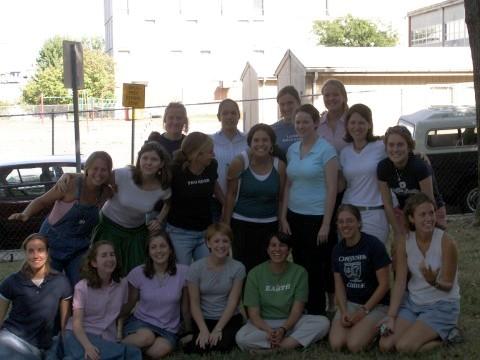
How blessed am I. About 18 wretches, and many others, came to my house on Monday for a picnic. It was great fun all around but I want to focus on the fact that there are over 18 young women in my life that I can trust not to talk "trash" about me, not to make fun of me, and more than that, who affirm me and love me even though I am wretched. Some of them met for the first time that day, and in the way of true Christian friendship, you would think they had been friends for years. Sr. Lightning, for example, may be our newest member but she certainly belongs. We stood outside the campus apts coordinating rides just laughing and hugging and greeting each other. We sat in my living room and sang some praise and worship. Rarely will you hear a more beautiful sound. We are seeking holiness and encouraging each other on the way. We do not become saints alone.
There is potential to start a "fraternal order" in one of our brothers in Christ. It's kind of tempting. But I think there is something special to our sisterhood because of the aforementioned conversation and others like it. We really are witnessing to the truth and beauty of living in Christ by not succumbing to so-called "typical" female friendship patterns. I think there are about 26 of us in total so far... 26 young, normal, wretched women who will support each other on the way to Heaven. I hope to post a picture from the picnic soon.
Happy Birthday, Mary! What is it, 2018? :)
I was completely baffled. Not that I haven't seen these kinds of friends before, or girls treating each other that way. But I thought, surely, this is not still present to such a degree that people have never seen true friendship among women.
How blessed am I. About 18 wretches, and many others, came to my house on Monday for a picnic. It was great fun all around but I want to focus on the fact that there are over 18 young women in my life that I can trust not to talk "trash" about me, not to make fun of me, and more than that, who affirm me and love me even though I am wretched. Some of them met for the first time that day, and in the way of true Christian friendship, you would think they had been friends for years. Sr. Lightning, for example, may be our newest member but she certainly belongs. We stood outside the campus apts coordinating rides just laughing and hugging and greeting each other. We sat in my living room and sang some praise and worship. Rarely will you hear a more beautiful sound. We are seeking holiness and encouraging each other on the way. We do not become saints alone.
There is potential to start a "fraternal order" in one of our brothers in Christ. It's kind of tempting. But I think there is something special to our sisterhood because of the aforementioned conversation and others like it. We really are witnessing to the truth and beauty of living in Christ by not succumbing to so-called "typical" female friendship patterns. I think there are about 26 of us in total so far... 26 young, normal, wretched women who will support each other on the way to Heaven. I hope to post a picture from the picnic soon.
Happy Birthday, Mary! What is it, 2018? :)
Tuesday, September 06, 2005
Patience
"God intended man to have all good, but in his, God's, time; and therefore all disobedience, all sin, consists essentially in breaking out of time. Hence the restoration of order by the Son of God had to be the annulment of that premature snatching at knowledge, the beating down of the hand outstretched toward eternity, the repentent return from a false, swift transfer into eternity to a true, slow, confinement in time. Hence the importance of patience in the New Testament, which becomes the basic constituent of Christianity, more central even than humility: the power to wait, to persevere, to hold out, to endure to the end, not to transcend one's own limitations, not to force issues by playing the hero or the titan, but to practice the virtue that lies beyond heroism, the meekness of the lamb which is led."
~Hans Urs Von Balthasar
~Hans Urs Von Balthasar
Thursday, September 01, 2005
Fun with Patristics
I have my first class on Marriage and Family in Patristic Theology later today, so I thought I'd do a bit of the reading...
Origen: "Our inner man consists of spirit and soul. The spirit is said to be male; the soul can be called female. If these have concord and agreement among themselves, they increase and multiply by the very accord among themselves and they produce sons, good inclinations and understandings or useful thoughts, by which they fill the earth and have dominion over it... But now if the soul, which has been united with the spirit and, so to speak, joined in wedlock, turn aside at some time to bodily pleasures... She will be punished, therefore, like a harlot and her sons will be ordered to be prepared for slaughter."
No word on what happens to a man, spirit, if he strays.
St. Ambrose: "Accordingly, the Lord declared that it was not good for man to be alone, because the human race could not have been propagated from man alone... For the sake, therefore, of the successive generations of men it followed that woman had to be joined to man... God said, 'Let us make him a helper like himself.' We understand that to mean a helper in the generation of the human family-- a really good helper... even though in an inferior position. We find examples of this in our own experience. We see how men in high and important offices often enlist the help of men who are below them in rank and esteem."
Wow. This class is going to be interesting. When you read these things, it's easier to see where some people are coming from when they think that certain doctrines should change. It's amazing how much we know now, even just in exegesis, like the word used for "helper" and all it entails... If only we were better at communicating things...
Origen: "Our inner man consists of spirit and soul. The spirit is said to be male; the soul can be called female. If these have concord and agreement among themselves, they increase and multiply by the very accord among themselves and they produce sons, good inclinations and understandings or useful thoughts, by which they fill the earth and have dominion over it... But now if the soul, which has been united with the spirit and, so to speak, joined in wedlock, turn aside at some time to bodily pleasures... She will be punished, therefore, like a harlot and her sons will be ordered to be prepared for slaughter."
No word on what happens to a man, spirit, if he strays.
St. Ambrose: "Accordingly, the Lord declared that it was not good for man to be alone, because the human race could not have been propagated from man alone... For the sake, therefore, of the successive generations of men it followed that woman had to be joined to man... God said, 'Let us make him a helper like himself.' We understand that to mean a helper in the generation of the human family-- a really good helper... even though in an inferior position. We find examples of this in our own experience. We see how men in high and important offices often enlist the help of men who are below them in rank and esteem."
Wow. This class is going to be interesting. When you read these things, it's easier to see where some people are coming from when they think that certain doctrines should change. It's amazing how much we know now, even just in exegesis, like the word used for "helper" and all it entails... If only we were better at communicating things...
Tuesday, August 30, 2005
Communio Personarum: Trinity and Church
The title of my class today. I'm so glad to be back in class!! I was never meant to work full-time ;) and while my mind will take a few weeks to adjust (it always does), it's very happy to be working again.
So, the Trinity. What an ambitious topic. Our readings today were from Henri de Lubac, John Paul II, and Cardinal Ratzinger. Father began with "Man is desire to know" from Metaphysics. The human being is a web of relations. We are always being created, being generated... I cannot account for myself from within myself; my self comes from an Other. Who we are is formed by how we are generated and brought forth.
There is a similar dynamic in knowledge. Knowledge is a mysterious process, by which the self leaves itself, appropriates what is known, and returns to itself enriched and changed. In a way, after you view the Grand Canyon, the Grand Canyon dwells in you. The more you know something, the more you are one with it. The more you know a person, the more you are one with him. Love is leaving room in yourself so that the other may come in.
Unity and difference. We tend to deny one and affirm the other. The revelation of the mystery of the Trinity in Jesus Christ is the only hypothesis that puts the two together without destroying them. In Christ, we see that the nature of Being itself is communion-- loving friendship. Where there is greater communion, there is greater unity. In God is the recognition of Otherness. When we call something a Mystery, we do not simply mean it is something beyond our grasp. We mean that it is Otherness. Mystery is a noun; a subject.
Knowledge of God comes only through conversion. Understanding God requires purification. Arius was reluctant to let go of a Greek mind. Since God had to be ungenerated in the Greek conception, Arius had to see Christ, the Generated One; as not being God. The only way to approach studying the Trinity is to humble yourself in front of the mystery of God, and be drawn into it.
That about summarizes my first class on the Trinity. Any questions? I don't quite follow my notes myself, but Fr. Antonio never fails to say something striking. Like this: "Saying 'I love you' contains a lie, is not true, if it doesn't praise God." and this: "When mystery is taken out of reality, reality itself becomes opaque [incomprehensible]."
So, the Trinity. What an ambitious topic. Our readings today were from Henri de Lubac, John Paul II, and Cardinal Ratzinger. Father began with "Man is desire to know" from Metaphysics. The human being is a web of relations. We are always being created, being generated... I cannot account for myself from within myself; my self comes from an Other. Who we are is formed by how we are generated and brought forth.
There is a similar dynamic in knowledge. Knowledge is a mysterious process, by which the self leaves itself, appropriates what is known, and returns to itself enriched and changed. In a way, after you view the Grand Canyon, the Grand Canyon dwells in you. The more you know something, the more you are one with it. The more you know a person, the more you are one with him. Love is leaving room in yourself so that the other may come in.
Unity and difference. We tend to deny one and affirm the other. The revelation of the mystery of the Trinity in Jesus Christ is the only hypothesis that puts the two together without destroying them. In Christ, we see that the nature of Being itself is communion-- loving friendship. Where there is greater communion, there is greater unity. In God is the recognition of Otherness. When we call something a Mystery, we do not simply mean it is something beyond our grasp. We mean that it is Otherness. Mystery is a noun; a subject.
Knowledge of God comes only through conversion. Understanding God requires purification. Arius was reluctant to let go of a Greek mind. Since God had to be ungenerated in the Greek conception, Arius had to see Christ, the Generated One; as not being God. The only way to approach studying the Trinity is to humble yourself in front of the mystery of God, and be drawn into it.
That about summarizes my first class on the Trinity. Any questions? I don't quite follow my notes myself, but Fr. Antonio never fails to say something striking. Like this: "Saying 'I love you' contains a lie, is not true, if it doesn't praise God." and this: "When mystery is taken out of reality, reality itself becomes opaque [incomprehensible]."
Tuesday, August 23, 2005
As promised...



A couple pictures from the Nash. Top is Sr. Anna and Miriam; Middle is me and Sr. Moon, who entered there a few days after this picture; Bottom is Sr. Alexandra and the baby.
Subscribe to:
Posts (Atom)